
The Military Trap: Why Roman Emperors Died More Violently Than Chinese Emperors

Abstract: This article presents a direct bilateral comparison of imperial survival in China and Rome during 27 BCE–476 CE. Using data on 58 Chinese and 97 Roman emperors, I document that Roman emperors faced a violent death rate of 60.8% (59/97), nearly double the Chinese rate of 31.0% (18/58) (p < 0.001). The gap persists across periods and […]
Public good or public bad? Nation-building and Indigenous institutions

Abstract: While existing evidence shows that nation-building policies unify societies, little is known about how and what makes some societal groups to resist them. We examine this in the context of the post-Mexican Revolution (1920s–1950s), when the new state implemented a nation-building policy to eliminate Indigenous cultures and identities by increasing connectivity via transport infrastructure. […]
Devaluation, Exports, and Recovery from the Great Depression

Abstract: This paper evaluates how a major policy shift—the suspension of the gold standard in September 1931—affected employment outcomes in interwar Britain. We use a new high-frequency industry-level dataset and difference-in-differences techniques to isolate the impact of devaluation on exporters. At the micro level, the break from gold reduced the unemployment rate by 2.7 percentage […]
Property rights, fiscal capacity, and social capacity: The lasting impact of the Taiping Rebellion

Abstract: We examine the long-term regional development effects of the Taiping Rebellion (1850–1864), one of the deadliest civil wars in human history and a critical juncture in China’s path toward modernity. Our analysis shows that some areas under the control of the Taiping regime experienced important institutional changes, including stronger land property rights, greater local […]
China’s anticorruption campaign and civil servant fever

Abstract: What is the impact of anticorruption efforts on entry into bureaucratic jobs? This paper approaches the question theoretically and empirically through the lens of China’s anticorruption campaign instituted in 2013. We leverage a novel data set of national civil service exams. Exploiting assignment and timing variations in anticorruption inspections of government departments, our difference-in-differences estimate […]
The Aftermath of Sovereign Debt Crises: A Narrative Approach

Abstract: This paper investigates the causal effects of sovereign debt crises in a sample of 50 defaulting economies between 1870 and 2010. As default is potentially endogenous, we use the narrative approach to identify plausibly exogenous episodes. We find economically and statistically significant costs of up to 3.2 percent of GDP before recovering to the […]
On the persistence of persistence: Lessons from long-term trends in African Institutions

Abstract: An influential strand of literature within economics and economic history called ‘persistence studies’ argues that low material living standards in African countries today were determined by institutional choices made in the past. However, the lack of consistent annual data on GDP per capita or institutional variables has meant that this literature has been largely […]
Urban Accounting and Welfare in Spain

Abstract: This paper uses a novel dataset and the general equilibrium model in Desmet and Rossi-Hansberg (2013) to analyze the Spanish city size distribution, which is driven by three city-specific characteristics: productivity, amenities, and frictions. Counterfactual simulations show that removing cross-city variation in these characteristics leads to welfare gains and population shifts in Spain larger […]
Pre-colonial institutions and economic development in Latin America: Evidence from a new ethnic homeland dataset

Abstract: This paper examines the effects of pre-colonial institutions on economic development in Latin America using historical ethnic homelands as the unit of analysis. We construct a newly digitised and georeferenced map of 257 ethnic homelands. Our results show a strong and positive relationship between pre-colonial institutions and contemporary economic development. Beyond the role of […]
The Short- and Long-Run Effects of Affirmative Action: Evidence from Imperial China

Abstract: We study the short- and long-term effects of affirmative action policies in the context of China. During imperial China, official positions were awarded to the most academically talented individuals through a multi-stage examination process administered by the central government. In 1712, a reform was implemented to address disparities in exam performance, aiming to equalize […]
Patently Peculiar: Patents and Innovation in the United Kingdom of the Netherlands

Abstract: We examine the accessibility and functioning of the patent system in the United Kingdom of the Netherlands, a state that existed between 1815 and 1830. The country’s patent law combined an examination process with significant government discretion over a patent’s duration and cost. Using our hand-collected database of all patent applications—granted, withdrawn, and rejected—we […]
Applying History to Inform Anticipatory AI Governance: Using Foresight and Hindsight to Inform Policymaking

Summary: Artificial intelligence (AI) heralds societal changes that could rival those associated with past transformational general-purpose technologies, such as metallurgy, the steam engine, electricity, and the internet. As with such technologies, AI offers the opportunity for tremendous increases in human well-being while also threatening to destabilize social, governance, economic, and critical infrastructure systems and disempower […]
The Evolution of the Irish 12.5 Percent Corporate Tax Rate: An Oral History

Abstract: The sources formally documenting how tax policy evolves fail to capture many of the complexities inherent in such processes. Insights into such approaches would guide other tax administrations in navigating tax policy change in an international domain. This paper examines the historical background to the introduction of the Irish 12.5 percent corporate tax rate […]
Precolonial Elites and Colonial Redistribution of Political Power
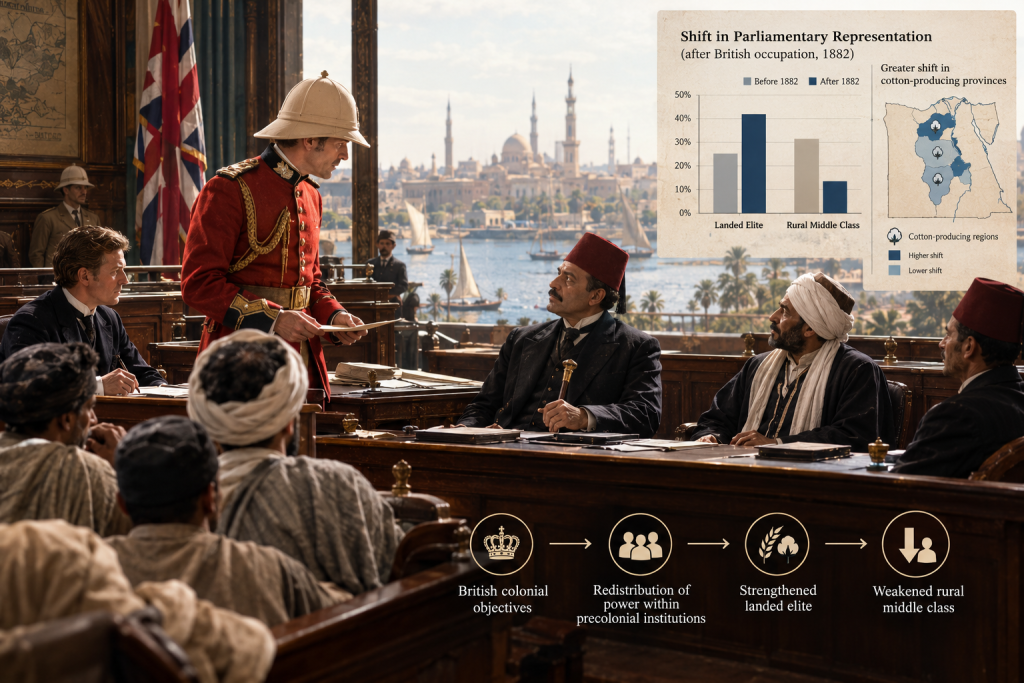
Abstract: Studies of colonialism often associate indirect colonial rule with continuity of the precolonial institutions. Yet, we know less about how colonialism affected the distribution of power between precolonial domestic elites within nominally continuous institutions. We argue that colonial authorities will redistribute power toward elites that are the most congruent with the colonizer’s objectives. We […]
The Empire project: Trade policy in interwar Canada

Abstract: This paper uses a new dataset on the universe of Canadian imports and tariffs between 1924 and 1936, disaggregated into 1697 goods originating in 112 countries, to analyse the impact on Canadian imports of interwar Canadian trade policy, including the 1932 Ottawa trade agreements. Rather than use a dummy variable approach, we compute the […]
Rally ’Round the Mask: Congressional Social Media Images and Masking during COVID-19

Abstract: During national crises, political elites often rally around the flag, promoting a central message to restore unity and calm the public. COVID-19 provided such a crisis. But did elites rally? The pandemic occurred at a point of extreme polarization in the United States, which threatens the potential for a rally. In this article, we […]
Central Bank Independence: Views from History and Machine Learning

Abstract: We assemble an almost complete set of central bank statutes since 1800 to assess the legal independence of central banking institutions. We use these to extend existing indices of legal independence backward and forward in time. We document the trend toward increased independence post 1980 as well as an earlier, more limited movement in […]
Mind Your Language: Explaining the Retreat of the Irish Language Frontier

Abstract: Why do we choose one language over another? Rival views see language frontiers as exogenous, driven by policy, or endogenous, determined by social, cultural and economic forces. We study language loss in nineteenth-century Ireland’s bilingual society using individual-level data from the 1901 census. Our analysis highlights the intergenerational influence of the education received by […]
Lobbying for Industrialization: Theory and Evidence

Abstract: Industrial policies, such as infrastructure investments and export tariffs, affect the allocation of labor and incomes across sectors, attracting substantial lobbying efforts by special interest groups. Yet, the link between structural change and lobbying remains underexplored. Using more than 150 years of data on parliamentary petitions in USA and Britain, we measure historical lobbying […]
A reappraisal of Cumann na nGaedheal economic policy

Abstract: This article surveys the economic policies pursued over the first decade of the Irish Free State. The Cumann na nGaedheal governments of W. T. Cosgrave are argued to have been more pragmatic than ideological in their approach and to have been more successful in their management of the economy than is generally realised. Keywords: […]
The Demand for Extraterritoriality: Religious Minorities in Nineteenth-Century Egypt

Abstract: The transplantation of European legal systems in the periphery often occurred via semi-colonial institutions, where Europeans were subject to their own jurisdictions that placed them outside the reach of local courts. In nineteenth-century Egypt, the option of extraterritoriality was extended to local non-Muslims. Drawing on Egypt’s population censuses in 1848 and 1868, we show […]
Deliberate Surrender? The Impact of Interwar Indian Protection

Abstract: What is the role of trade policy in promoting intra-Empire trade? We address the question in the context of interwar India, whose trade policies have been accused of harming British export interests. We quantify the impact of trade policy on the value and composition of Indian imports, using novel disaggregated data on both trade […]
The anatomy of a bubble company: The London Assurance in 1720

Abstract: The London Assurance Company (LA), which incorporated during the bubble of 1720, experienced more dramatic price movements in its shares than the South Sea Company. This paper examines how incorporating during the bubble affected its long run performance. We show that the bubble in the Company’s share price was partly attributable to changes in […]
Collective Victimhood Narratives in Far-Right Communities on Telegram

Abstract: Feelings of collective victimhood have been demonstrated to have a strong effect on ingroup bias, outgroup hostility and support for violence. The use of narratives stirring these feelings in far-right communications is especially concerning given their inclusion in the manifestos of several mass killers across Europe and North America. However, scholars still have little […]
Tracing Sustainability In The Long Run: Genuine Savings Estimates 1850 – 2018

Abstract: We introduce a new database of historical Genuine Savings (GS), an indicator of sustainable development promoted by the World Bank and widely used in contemporary economic research. GS derives from the theoretical work on wealth accounting, and addresses shortcomings in conventional metrics of economic development by incorporating broader measures of saving and investment, including […]
The Nationalist Dilemma: A Global History of Economic Nationalism, 1776–Present

Summary: Nationalists think about the economy, Marvin Suesse argues, and this thinking matters once nationalists hold political power. Many nationalists seek to limit global exchange, but others prioritise economic development. The potential conflict between these two goals shapes nationalist policy making. Drawing on historical case studies from thirty countries – from the American Revolution to […]
Was Marshall Right? Managerial Failure and Corporate Ownership in Edwardian Britain

Abstract: Alfred Marshall argued that the malaise of public companies in Edwardian Britain was due to the separation of ownership from control and a lack of professional management. In this paper, we examine the ownership and control of the c.1,700 largest British companies in 1911. We find that most public companies had a separation of […]