
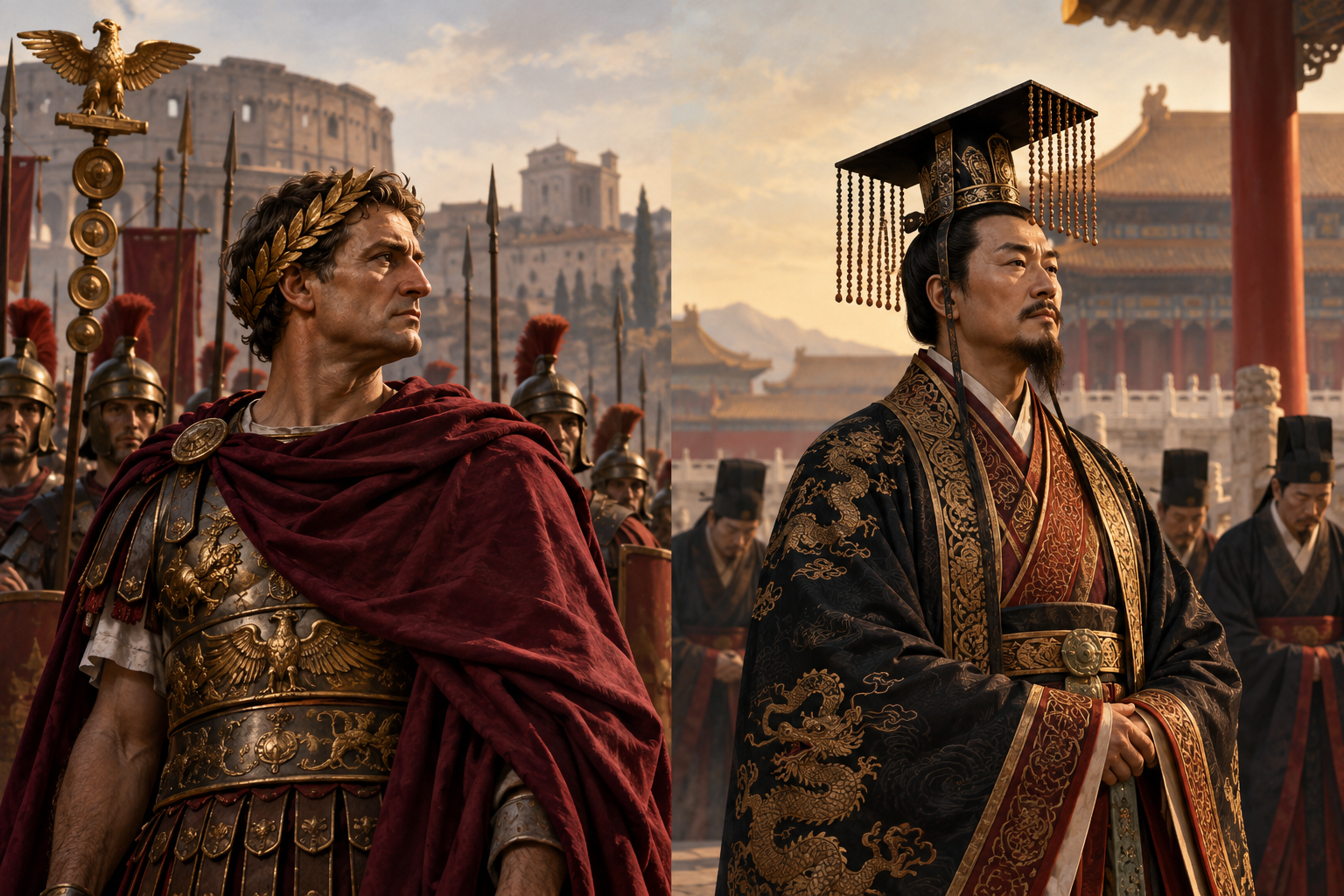
Abstract: This article presents a direct bilateral comparison of imperial survival in China and Rome during 27 BCE–476 CE. Using data on 58 Chinese and 97 Roman emperors, I document that Roman emperors faced a violent death rate of 60.8% (59/97), nearly double the Chinese rate of 31.0% (18/58) (p < 0.001). The gap persists across periods and is robust to controls for succession mode and period fixed effects. I argue that this gap is consistent with Rome’s reliance on military politics, where armies routinely elevated and deposed emperors – what I call the ‘military trap’. Roman emperors who acceded through military elevation died violently at 75.7% versus 51.7% for others, and from military-related causes at 48.6% versus 31.7%. Chinese imperial successions differed structurally: only seven emperors in the 500-year sample acceded through military-style elevation, all dynasty founders. Within established Chinese dynasties, irregular successions took the form of palace coups by regents, consort families, or eunuchs. The results speak to debates on political stability in pre-modern empires and civil-military relations in autocratic states.
Keywords: Imperial survival, Roman empire, Chinese empire, Military politics, Political violence
JEL Classification: N40, D73, D74
Cite as: Dong, Z. (2026). The military trap: why Roman emperors died more violently than Chinese emperors. Applied Economics Letters, 1–5. https://doi.org/10.1080/13504851.2026.2683696
DOI: https://doi.org/10.1080/13504851.2026.2683696